
There’s nothing quite like the comforting aroma and satisfying taste of freshly baked homemade bread, and this Italian bread recipe truly embodies that unparalleled delight. Imagine a loaf with a beautifully golden-brown, chewy crust that yields to an interior of pillowy softness, a tender crumb just waiting to be savored. This isn’t merely bread; it’s an experience – a connection to timeless culinary traditions and the simple joys of a well-made meal. Forget store-bought alternatives; once you try this warm, fresh homemade Italian bread, you’ll understand why it’s simply unbeatable.
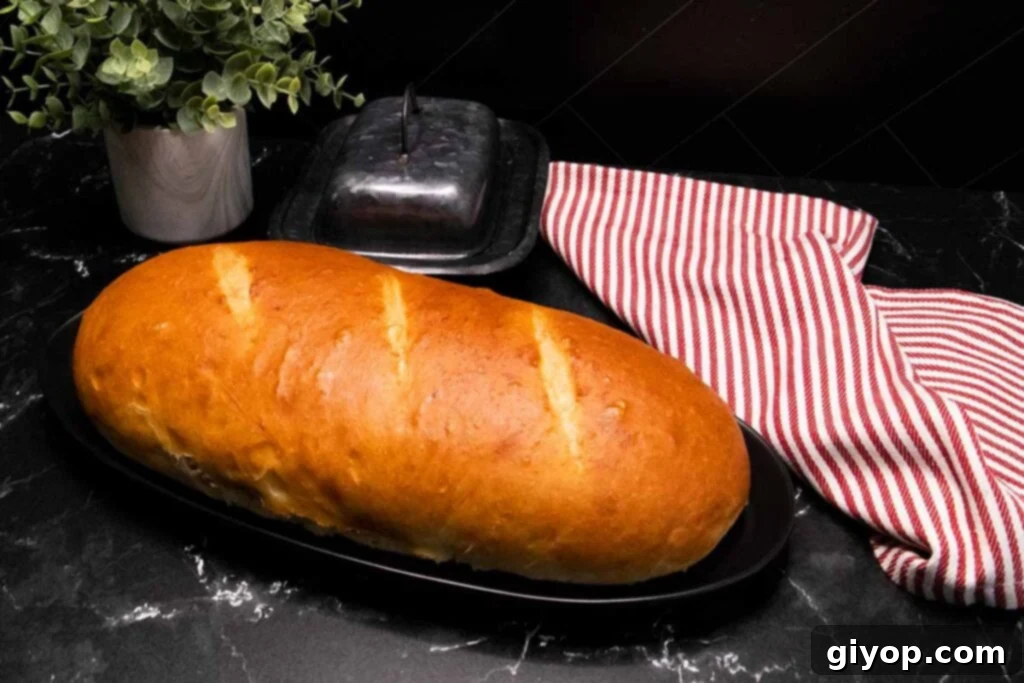
While my immediate family didn’t often bake bread at home, I hold cherished, albeit vague, memories of my Great Aunt Mary. She was renowned for her thoughtful visits, always arriving with two things: a fresh-from-the-oven loaf of her incredible homemade bread and a pair of her cozy, handmade crocheted socks. It was a comforting tradition, a testament to her love and skill, and those warm booties were always a welcome gift.
Why You’ll Love This Easy Italian Bread Recipe
This isn’t just another bread recipe; it’s a gateway to enjoying authentic Italian flavors with remarkable ease. Here’s why this homemade Italian bread will become a staple in your kitchen:
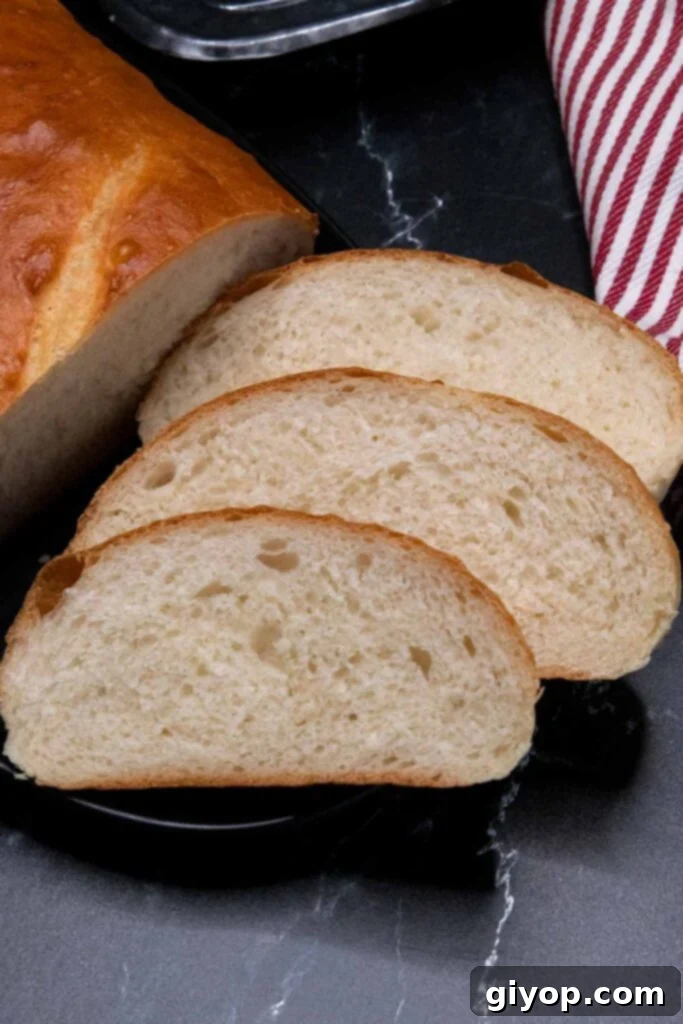
- Irresistible Texture: The perfect balance of a delightfully crisp and chewy crust with an incredibly soft, tender, and fluffy interior. Each bite is a symphony of textures.
- Flavorful Versatility: Whether it’s slathered generously with rich European butter, dipped into a fragrant, seasoned olive oil, or simply enjoyed plain, the nuanced flavor of this bread shines through.
- Perfect Pairing: This versatile loaf is the ultimate companion to virtually any of your favorite Italian dishes, from hearty pasta sauces and savory lasagna to vibrant antipasto platters and robust stews. It also makes fantastic sandwiches or garlic bread.
- Quick & Convenient: Despite its professional appearance and taste, this Italian bread recipe is surprisingly easy to make and can be completed in approximately two hours from start to finish. This means you don’t need to dedicate an entire day to baking; you can whip up a fresh loaf any day of the week!
- Sense of Accomplishment: There’s immense satisfaction in pulling a golden, fragrant loaf of bread from your own oven. The aroma alone is worth the effort!
Essential Ingredients for Homemade Italian Bread
Crafting the perfect Italian bread requires a few simple, high-quality ingredients. Here’s what you’ll need and why each component is important:
- Active Dry Yeast: This is the leavening agent that gives our bread its wonderful rise and airy texture. If you happen to be using instant yeast, you can skip the initial activation step in warm water and add it directly to the dry ingredients, though proofing is still recommended to ensure it’s active.
- Water: You’ll use warm water (around 105-110°F or 40-43°C) to activate the active dry yeast, providing the ideal environment for it to thrive. Additionally, hot water (not boiling) will be incorporated into the dough mixture. Don’t worry, the hot tap water quickly cools down when combined with other ingredients, ensuring it won’t harm the yeast.
- Granulated Sugar: A small amount of sugar serves as food for the yeast, helping it to activate and multiply, leading to a better rise. It also contributes to the bread’s beautiful golden-brown crust and a subtle sweetness.
- Olive Oil: Essential for a tender crumb and a richer flavor. Olive oil also helps keep the bread soft and moist, preventing it from drying out quickly.
- Kosher Salt: More than just a flavor enhancer, salt plays a crucial role in controlling yeast activity and strengthening the gluten structure in the dough, which results in a better texture.
- Bread Flour: While all-purpose flour can be used, bread flour is highly recommended. It has a higher protein content, which develops more gluten, yielding a chewier texture and a more tender, open crumb – characteristic of excellent Italian bread.
- Egg (for egg wash): An egg whisked with a tablespoon of water creates a lustrous egg wash. This is brushed over the loaf before baking to give the crust a beautiful golden color and a slight sheen, while also helping any toppings adhere.
Expert Tips for Baking Flawless Italian Bread
Achieving bakery-quality Italian bread at home is simpler than you think with these crucial tips:
- Measure Flour Correctly: The amount of flour can significantly impact the dough’s consistency. Always aerate your flour by spooning it into your measuring cup and then leveling it off with a straight edge. Never scoop directly from the bag, as this compacts the flour and can add too much.
- Temperature is Key for Yeast: For active dry yeast, warm water should ideally be between 105°F and 110°F (40-43°C). If the water is too hot, it will kill the yeast, preventing the dough from rising. If it’s too cool, the yeast will activate too slowly, resulting in a sluggish rise. A thermometer is your best friend here.
- Choose the Right Mixer Attachment: When using a stand mixer, the paddle attachment is often more effective for this particular dough initially, as it mixes the ingredients thoroughly, especially when the dough is very soft and sticky. A dough hook might not incorporate ingredients as effectively at the beginning. Once the dough starts to come together, you can switch to the dough hook for kneading, or continue with the paddle if it works for your mixer and consistency. Mixing by hand is also a perfectly viable option, providing a tactile feel for the dough’s development.
- Resist Adding More Flour: This dough is intentionally very soft and sticky at first. It can be tempting to add more flour to make it easier to handle, but this will result in a dense, dry, and heavy bread. Trust the process; the dough will become more manageable after its first rise.
- Create an Ideal Rising Environment: Yeast dough loves warmth and a draft-free environment. A simple trick is to use your oven light: turn the oven light on while you’re mixing the dough. By the time you’re ready for the first rise, the residual warmth from the light will create a perfectly cozy, warm (but not hot) spot for your dough to rise beautifully.
- Understand the Stages of Rising: The first rise (bulk fermentation) develops flavor and gluten. The second rise (proofing) is about achieving the final airy texture. Don’t rush these stages.
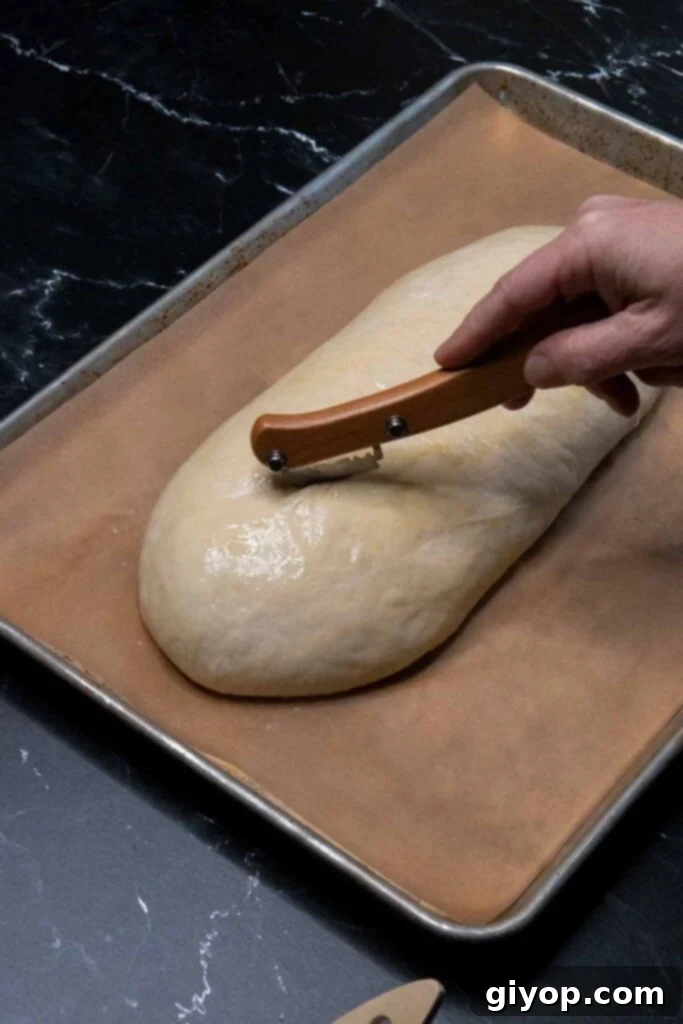
- Proper Scoring: The cuts on top of the loaf (scoring) aren’t just for aesthetics. They allow the bread to expand predictably in the oven, preventing uncontrolled cracking and promoting a superior rise and open crumb. Use a very sharp knife or a bread lame.
- Cooling is Crucial: While it’s tempting to slice into a warm loaf immediately, allowing the bread to cool for at least 15 minutes (or even longer) before slicing is essential. This allows the internal structure to set and the moisture to redistribute, resulting in a better texture and preventing a gummy interior.
How to Make the Best Homemade Italian Bread: Step-by-Step Guide
Follow these detailed steps to bake your own magnificent loaf of Italian bread:
1. Proof the Yeast
Begin by activating your active dry yeast. In a small bowl, combine 1 packet (2 1/4 teaspoons) of active dry yeast with 1/4 cup of warm water (precisely 105°F to 110°F or 40-43°C) and 1/4 teaspoon of granulated sugar. Stir gently to dissolve the yeast and sugar. Let this mixture stand undisturbed for about 5 minutes. You’ll know the yeast is active and ready when a foamy layer forms on the surface, indicating its lively fermentation.
2. Combine Wet Ingredients and Initial Flour
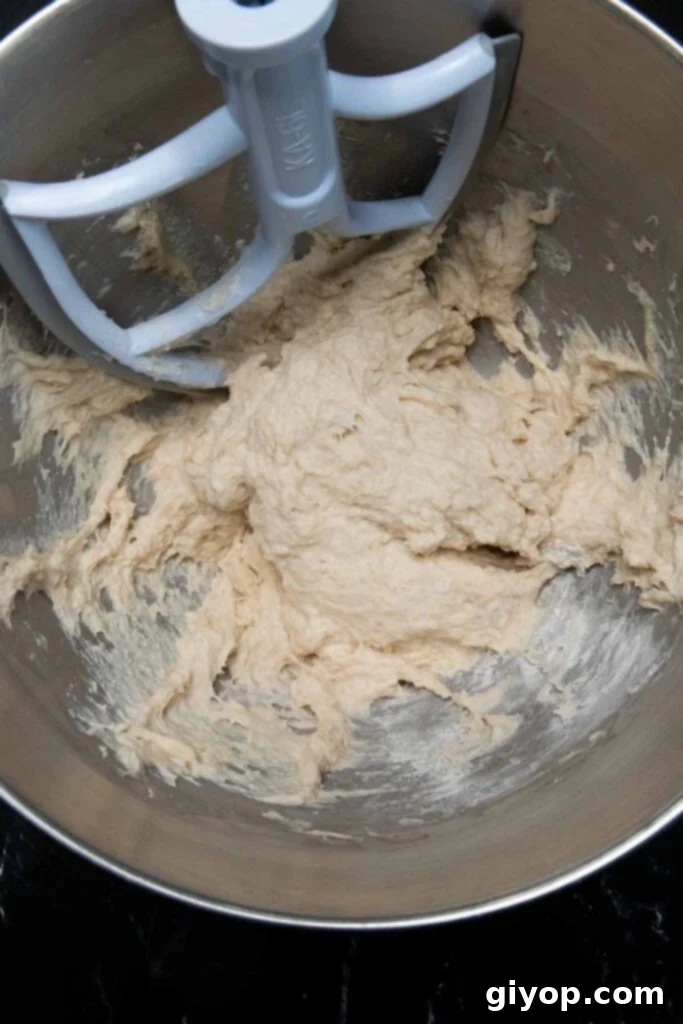
In the large bowl of a stand mixer (or a large mixing bowl if kneading by hand), combine 1 cup of hot tap water (ensure it’s hot but not boiling), 1 tablespoon of granulated sugar, 1 1/2 teaspoons of kosher salt, and 1/4 cup of olive oil. Mix these ingredients briefly. Then, add 1 1/2 cups of bread flour and begin mixing on low speed with the paddle attachment. This initial mixing helps to hydrate the flour evenly. Next, pour in the proofed yeast mixture and continue mixing on low speed until everything is well combined.
Note: We’ve found that for this particular dough, the paddle attachment of a stand mixer works more effectively than the dough hook in the initial mixing stages, ensuring all ingredients are thoroughly incorporated. However, you can certainly mix the entire dough by hand if you prefer.
3. Add Remaining Flour and First Rise
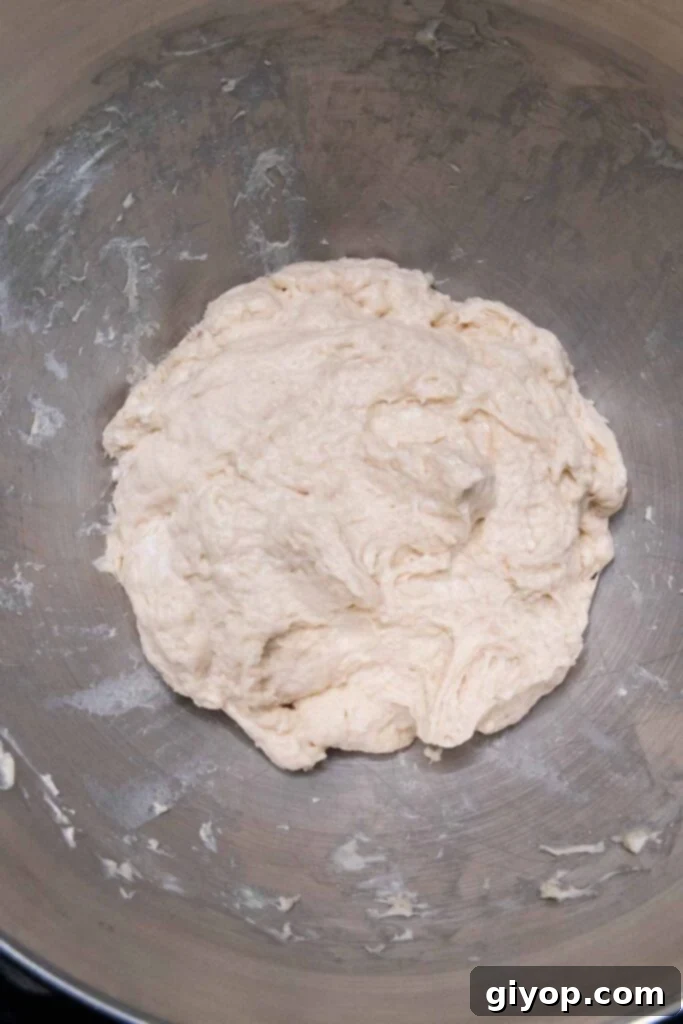
Gradually add the remaining 1 3/4 cups of bread flour to the mixer. Continue mixing on low speed until all the flour is fully incorporated and the dough comes together. At this point, the dough will be quite soft and noticeably sticky – this is perfectly normal and desired for a light, airy Italian bread. Use a rubber spatula to scrape down the sides of the bowl, gathering all the dough into the center. Cover the bowl tightly with plastic wrap or a damp kitchen towel and let it rise in a warm, draft-free place for 1 hour. During this time, the dough should roughly double in size.
4. Shape the Loaf
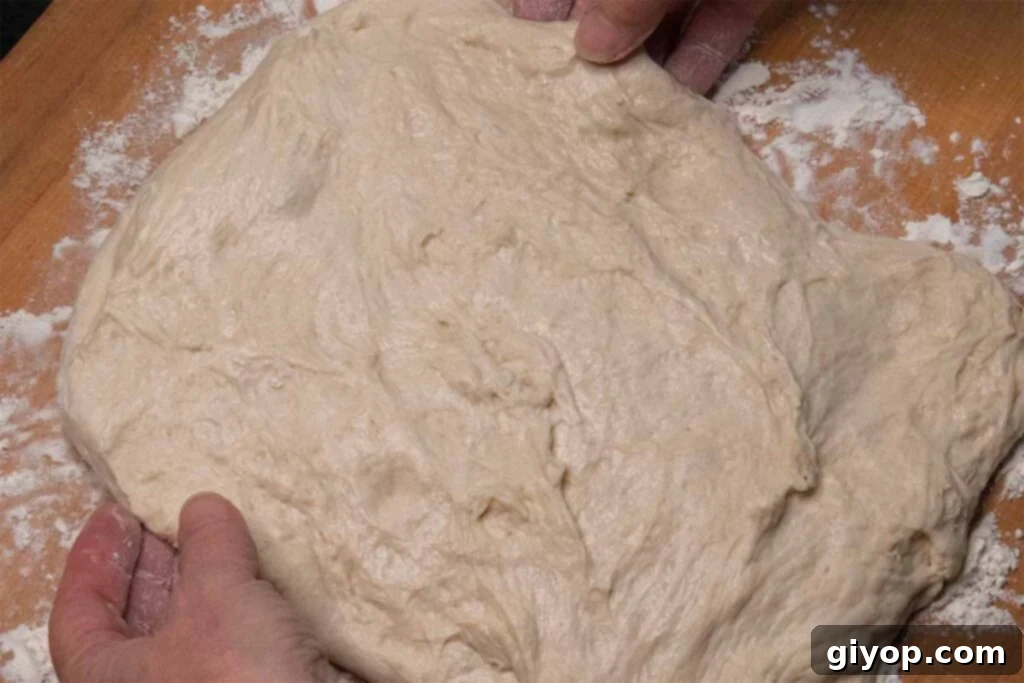
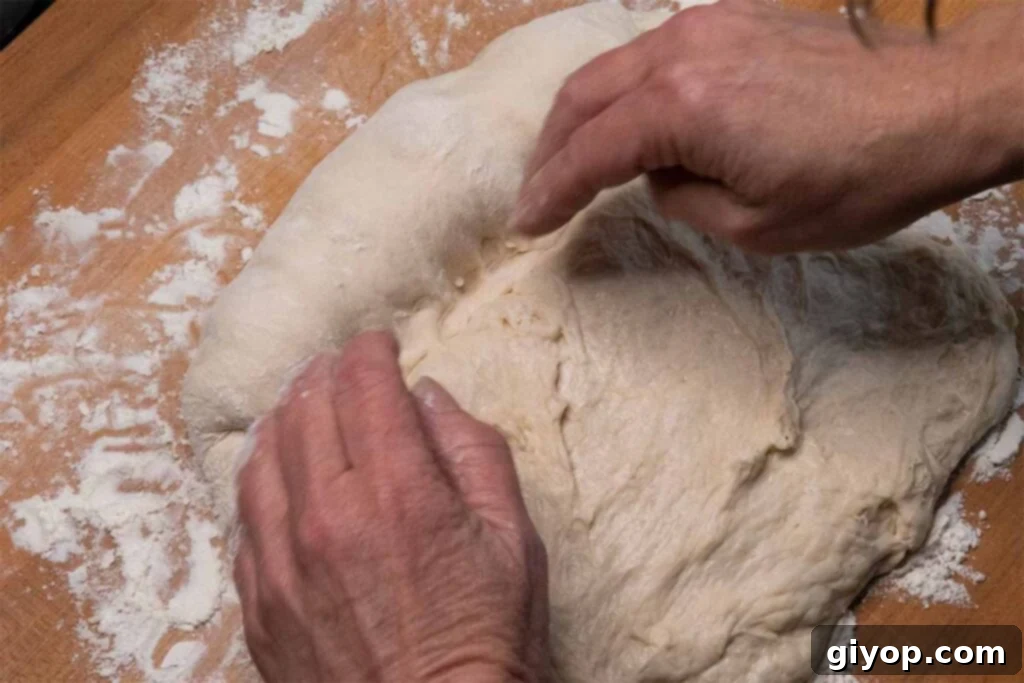
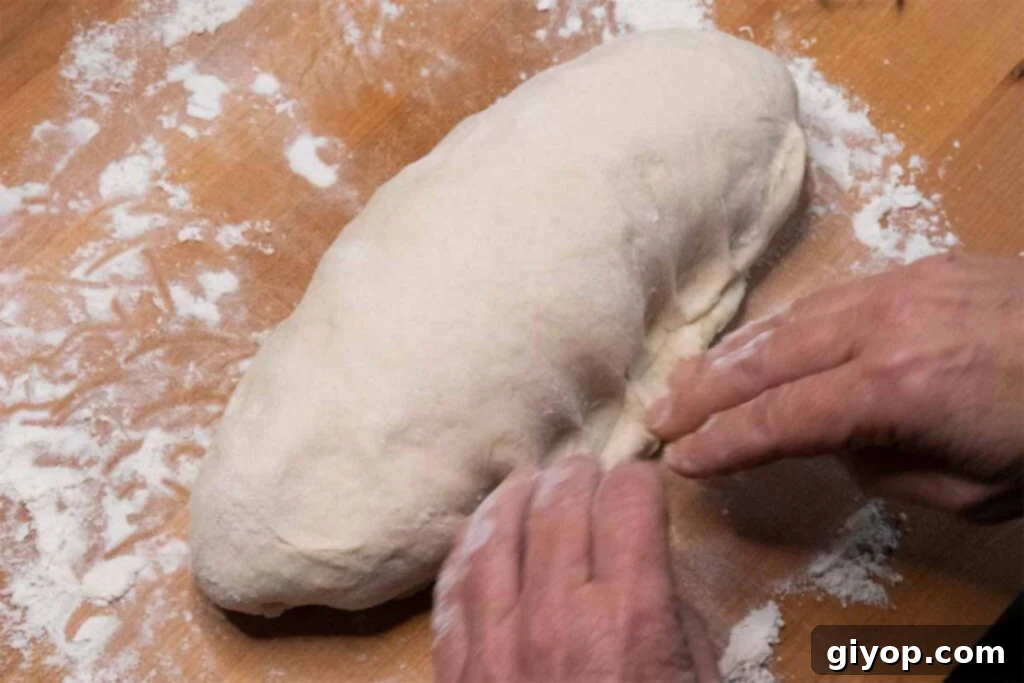
While the dough is rising, prepare a large baking sheet by lining it with parchment paper; this prevents sticking and aids in easy cleanup. After the hour-long first rise, the dough will be soft and elastic. Gently scrape the risen dough out onto a lightly floured work surface or a large cutting board. With floured hands, gently flatten the dough into an oblong rectangle. Starting from the side closest to you, begin to roll the dough tightly, jellyroll style. As you roll, gently seal the dough and fold in the two corners after each full rotation to create tension. Once rolled, firmly pinch and seal the final seam closed and gently tuck the ends under to create a neat, uniform loaf shape.

5. Second Rise and Oven Preheat
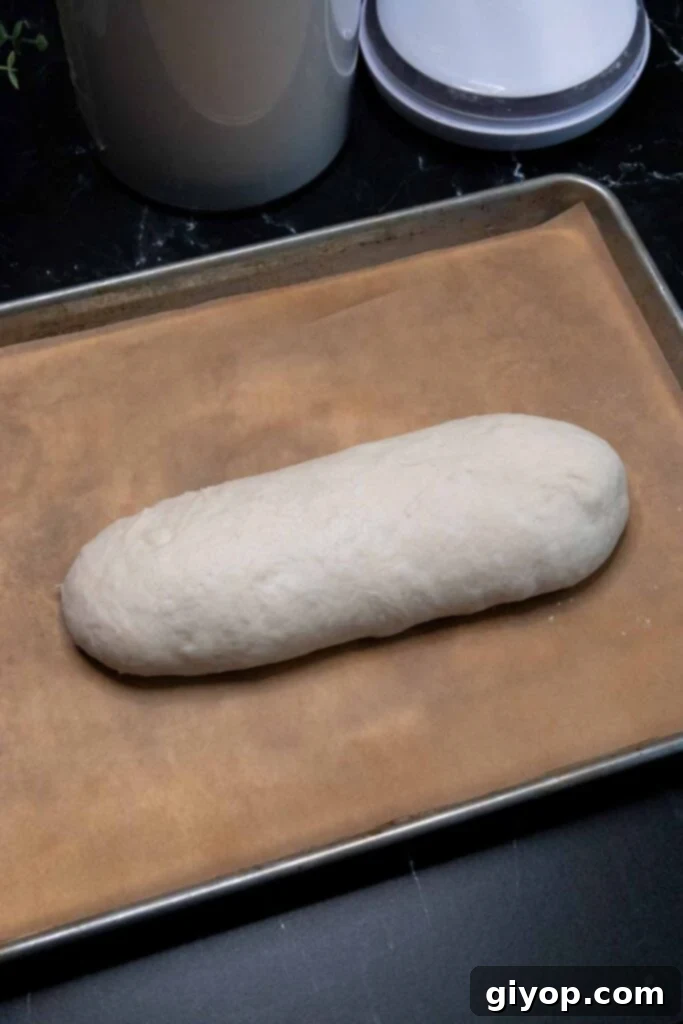
Carefully transfer the shaped loaf, seam-side down, onto the prepared parchment-lined baking sheet. Cover it loosely with plastic wrap or a clean kitchen towel and let it undergo its second rise for another 30 minutes in a warm place. During this time, the loaf will puff up slightly. About 15 minutes into the second rise, preheat your oven to 375°F (190°C). While the oven preheats, prepare your egg wash by whisking one large egg with 1 tablespoon of water in a small bowl until well combined.
6. Egg Wash and Scoring
Once the 30-minute second rise is complete, gently brush the entire surface of the risen loaf with the egg wash. This will contribute to a beautifully golden and glossy crust. Next, using a bread lame (a specialized scoring tool) or a very sharp knife held at a slight angle, make three or four diagonal cuts across the top of the loaf. These cuts allow the bread to expand properly in the oven, creating a professional look and contributing to the desired texture.
7. Bake to Golden Perfection
Place the baking sheet with the prepared loaf into the preheated oven. Bake for 20 to 25 minutes, or until the crust achieves a deep, golden-brown color and the internal temperature reaches approximately 200-210°F (93-99°C). The bread should sound hollow when tapped on the bottom.
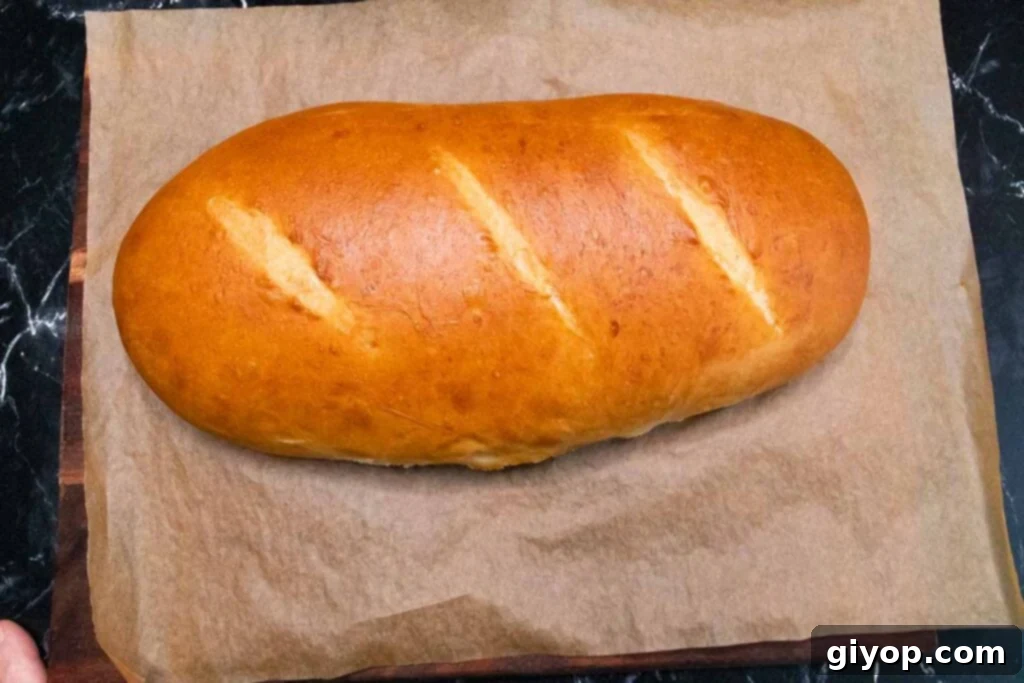
8. Cool and Enjoy
Once baked, immediately transfer the hot loaf from the baking sheet to a wire rack to cool completely. This prevents the bottom from becoming soggy. It’s incredibly difficult, but try to resist slicing into the bread for at least 15 minutes. This cooling period is crucial for the internal structure to set properly and for the moisture to redistribute, ensuring a perfect texture. When ready, slice into your warm, pillowy soft homemade Italian bread and savor every bite!
During our testing, we found that methods like placing a pan of water in the oven or spraying the oven with water did not significantly alter the outcome of this particular Italian bread recipe. Its robust crust and tender crumb develop wonderfully without these extra steps, making the process even simpler.
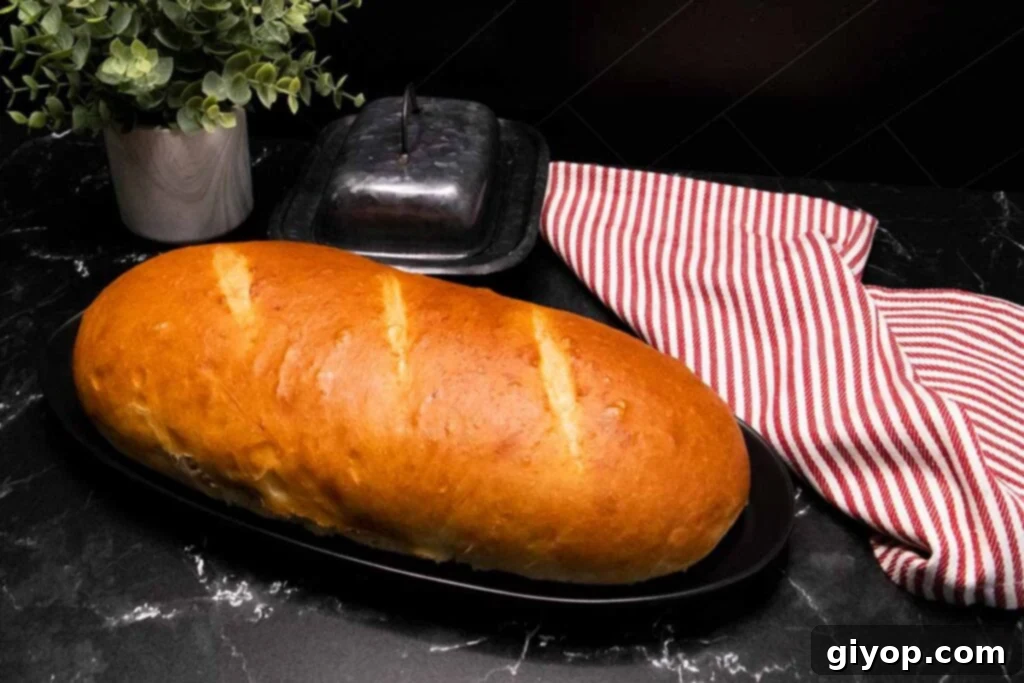
This recipe is truly fantastic because it’s both straightforward and quick, yielding delicious results in just a couple of hours. Imagine having warm, fresh Italian bread ready any day you crave it!
Are you on Pinterest? Click the button below to add this recipe to one of your boards!
Frequently Asked Questions About Italian Bread
Yes, you can prepare the dough ahead. If you choose to refrigerate the dough, be aware that it will continue to rise slowly in the cold environment. For best results, refrigerate for no more than 24 hours. Alternatively, for longer storage, you can freeze the dough. Wrap it tightly in plastic wrap, then place it in freezer-safe bags or containers. It can be stored in the freezer for up to 3 months. When you’re ready to bake, thaw the frozen dough at room temperature for about 4 hours until it’s pliable, then proceed with the recipe instructions for shaping and baking.
To maintain its freshness, store any leftover homemade Italian bread in an airtight container or a sealed plastic bag at room temperature. It will remain delicious for approximately 3-4 days. For an extended shelf life, especially in warmer climates, you can refrigerate the bread for up to 7 days, though it may dry out slightly faster in the fridge.
Absolutely! Freezing baked Italian bread is an excellent way to preserve its quality. Once the bread has completely cooled, wrap it tightly in plastic wrap, then place it in a freezer-safe bag or container. It will retain its best quality for about 1 month. To enjoy, simply thaw at room temperature, and for a “freshly baked” experience, warm it in a preheated oven for a few minutes.
Dense bread can often be attributed to a few factors. It might be due to using water that was too hot or too cold, killing or slowing the yeast. Insufficient kneading can also prevent gluten from developing, leading to a weak structure. Overworking the dough or adding too much extra flour during kneading and shaping can also result in a heavy loaf. Ensure your yeast is active, measure accurately, and trust the dough’s initial stickiness.
Yes, this recipe is highly adaptable! To make an herb-infused Italian bread, incorporate 1-2 tablespoons of dried Italian herbs, dried oregano, or finely chopped fresh rosemary during the initial mixing stage with the flour. For a cheesy version, you can fold in 1/2 to 1 cup of shredded Parmesan, mozzarella, or a blend of Italian cheeses during the last few minutes of mixing, or sprinkle it on top before baking for a delicious crust.
Other Great Bread Recipes to Explore
- Easy White Bread Recipe
- Italian Easter Bread
- Sourdough Bread Recipe
- No Knead Large Dutch Oven Bread
Italian Bread Recipe
Print
Pin
Ingredients
To Proof the Yeast
- 1 packet Active dry yeast (2 1/4 tsp)
- 1/4 cup Warm water
- 1/4 tsp Granulated sugar
For the Dough
- 1 cup Hot water (Hot tap water, not boiling)
- 1 tbsp Granulated sugar
- 1 1/2 tsp Kosher salt
- 1/4 cup Olive oil
- 3 1/4 cups Bread flour (divided)
Instructions
- Dissolve the active dry yeast and 1/4 teaspoon granulated sugar in 1/4 cup of warm water (110 degrees F). Let it stand to proof for about 5 minutes. It should be foaming on the top.
- In a large bowl of a stand mixer combine 1 cup of hot water, 1 tablespoon of granulated sugar, kosher salt, and olive oil. Add 1 1/2 cups of bread flour mix on low with the paddle attachment. Add the yeast mixture and mix on low to combine.
- Add the remaining 1 3/4 cup of bread flour and mix on low until well combined. The dough will be very sticky at this point. Scrape down the sides of the bowl, cover, and let rise for 1 hour. (This bread dough is very soft but should be easy to handle. Resist adding more flour.)
- Prepare a baking sheet with parchment paper.
- After the one-hour rise time, scrape the dough out onto a well-floured work surface or large cutting board. Gently flatten the dough into a rectangle. Start rolling the dough toward you jellyroll style, gently seal, fold in the two corners after each roll. Seal the seam and tuck the ends under.
- Place seam side down on the parchment-lined baking sheet. Cover and let rise another 30 minutes.
- Preheat the oven to 375 degrees F. Whisk a large egg with 1 tablespoon of water.
- After the 30 minute rise brush the loaf with the egg wash and using a bread lame or sharp knife make three or four cuts diagonally across the top of the loaf.
- Bake for 20 to 25 minutes until golden brown. Allow the bread to cool for at least 15 minutes before slicing.