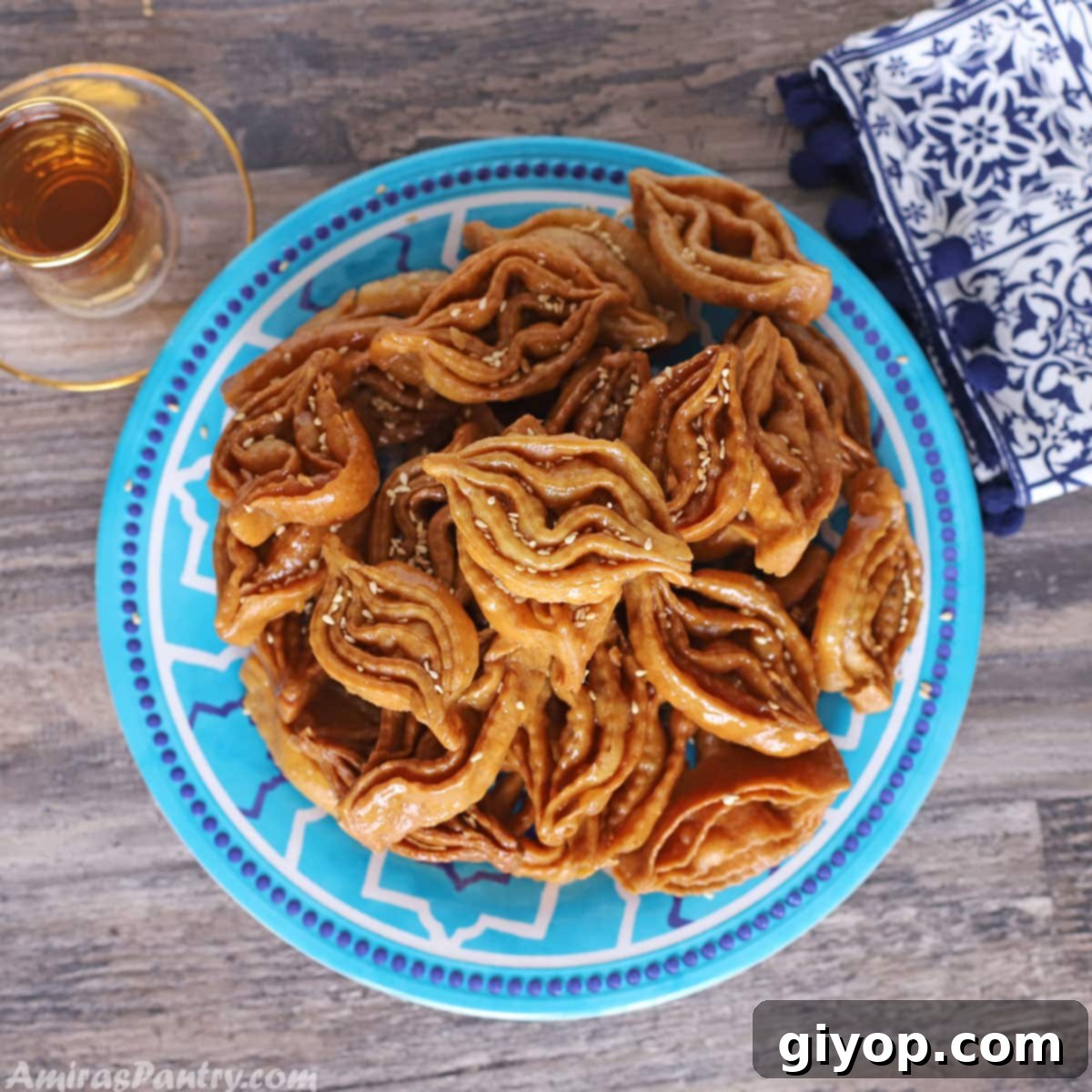
Moroccan Chebakia, also known as Halwa Chebakia or Mkharka, stands as a crowning jewel among traditional Moroccan sweets. These intricately crafted, flower-shaped cookies are a testament to rich culinary heritage, featuring roasted sesame seeds infused into a delicate dough, fried to golden perfection, and then generously drenched in fragrant honey. A staple during the holy month of Ramadan, Chebakia is traditionally enjoyed alongside a warm bowl of Harira soup, gracing tables during special occasions and festive gatherings throughout Morocco and beyond. Their unique texture—crispy, yet tender, and beautifully sticky with honey—makes them an irresistible treat that embodies the warmth and hospitality of Moroccan culture.
While Chebakia might seem like a labor of love, this detailed guide simplifies the process, making these exquisite honey-sesame cookies achievable in your home kitchen. For those who appreciate sweet fried delights, you might also enjoy these easy sweet cheese fritters.
Making Chebakia is often a communal affair in Morocco, a cherished family event where women gather to prepare large batches, sharing laughter and stories as they meticulously shape each cookie. This tradition highlights the importance of connection and shared effort in Moroccan cuisine. However, our adapted recipe is designed to be manageable for modern schedules, allowing you to create a generous batch of these delightful pastries without dedicating an entire day. If you enjoy pastries with a beautiful, intricate design, you might also be keen to try this wonderful Tunisian Debla, another rose-shaped delicacy.
Why This Chebakia Recipe Works So Well
This Chebakia recipe is specifically designed with convenience and ease in mind, making it perfect for busy individuals who still want to savor the authentic taste of Moroccan traditions. We understand that shaping these elaborate cookies can appear daunting or overly complex at first glance. That’s why this recipe introduces a brilliantly simple, yet effective, method for shaping Chebakia: utilizing a small, everyday kitchen cup. This innovative technique demystifies the shaping process, transforming what is often considered the most challenging step into an enjoyable and accessible task for all skill levels. By simplifying the shaping and scaling down the batch size, this recipe ensures that you can effortlessly create these beautiful, traditional cookies without feeling overwhelmed, allowing you to enjoy fresh, homemade Chebakia even on your busiest days.
Essential Ingredients for Authentic Chebakia
Important Ingredient Notes for Best Results
- Almond Meal Substitute: If almond meal is not readily available, or if you prefer a nut-free version, you can easily substitute it by increasing the amount of sesame seeds in the recipe. This will still yield a rich, nutty flavor profile while maintaining a similar dough consistency.
- Flavoring Spices: Anise, fennel, and cinnamon are key to Chebakia’s distinctive aromatic profile. These spices contribute significantly to the authentic Moroccan taste. However, if you don’t have one of them, or if you have a strong preference for or against a particular spice, feel free to adjust the amounts or substitute one for another. The goal is to create a flavor balance that you enjoy.
- Egg Yolk Usage: This recipe calls for only the egg yolk, which contributes to the dough’s richness and golden color when fried. Don’t let the egg white go to waste! Save it for another culinary creation, perhaps something light and airy like a Pavlova.
Step-by-Step Instructions to Make Chebakia
Note: This section provides a clear, concise overview of the instructions. More detailed guidance and tips are integrated directly within the recipe card below to ensure a smooth cooking experience.
- Begin by preparing your saffron: In a small bowl, combine orange blossom water with saffron threads. Gently rub the saffron with your fingers to help it release its vibrant color and aroma. Set this mixture aside to bloom while you prepare the other ingredients.
- Next, process the toasted sesame seeds: In a small food processor, pulse the toasted sesame seeds until they transform into a moist, sand-like texture. Be careful not to over-process them, as they can quickly turn into a thick sesame butter, or tahini, which is not what we want for this recipe.
- Combine wet and dry ingredients: In the bowl of your stand mixer, or a large mixing bowl, add the melted ghee (or unsalted butter) and oil mixture to your sifted dry ingredients. Incorporate the egg yolk and the saffron-infused orange blossom water.
- Knead the dough: Mix all ingredients thoroughly until a cohesive dough forms. Wrap the dough tightly in plastic wrap and let it rest for a minimum of 10 minutes. This resting period allows the gluten to relax, making the dough easier to roll and shape.
- Prepare the dough sections: Divide the rested dough into four equal sections. Take one section and roll it out on a lightly floured surface into a rectangular or oval shape, aiming for a thickness of about 3mm. Keep the remaining dough covered to prevent it from drying out.
- Fold the dough: Fold one short end of the rectangle towards the middle, then bring the other short end to meet it, creating a multi-layered strip. Fold it over once more to form a compact rectangle with four layers. This folding technique creates the characteristic flaky layers of Chebakia.
- Roll thinly: Using a rolling pin, roll the folded dough as thinly as possible. The thinner the dough, the crisper your Chebakia will be after frying.
- Cut into strips: Once rolled, use a fluted pastry wheel to cut the dough into uniform strips, approximately 2cm (¾ inch) wide and 42-45cm (17-18 inches) long. Trim any uneven edges for a neat finish.
- Innovative shaping technique: Here’s a brilliant and simple method for shaping Chebakia. Take any small cup from your kitchen and wrap one dough strip around its base, completing about two and a half rotations.
- Seal and remove: Gently press the end of the dough strip against the wrapped portion to seal it. Carefully remove the cup, leaving the coiled dough in its place.
- Pinch the ends: Pinch the two ends of the coiled dough firmly together. This crucial step prevents the cookie from unraveling during the frying process.
- Form the flower: Gently separate the inner strips of the dough to fan them out slightly. This creates the classic elongated flower shape that defines Chebakia. Repeat this process with the remaining dough strips.
- Prepare for frying: Arrange the shaped Chebakia cookies on a baking sheet lined with plastic wrap. Keep them covered until you have finished shaping the entire batch of dough.
- Deep fry the cookies: Heat a generous amount of oil in a deep pot or fryer over medium heat. Once the oil is hot, carefully place the Chebakia in batches, ensuring not to overcrowd the pan. Fry until they turn a beautiful golden brown color on both sides.
- Drench in honey: Immediately after frying, transfer the hot Chebakia into a wide bowl filled with honey. It’s important for the cookies to be hot when they enter the honey; a gentle sizzle indicates optimal absorption.
- Drain and cool: Using a slotted spoon, carefully remove the Chebakia from the honey, allowing any excess to drip back into the bowl. Place them on a wire rack set over a tray to cool completely for several hours, which also allows more honey to drain. Garnish with additional roasted sesame seeds if desired.
Expert Tips for Perfect Chebakia Every Time
- Dough Thinness: Achieving a very thin dough is crucial for crispy Chebakia. While some prefer using a pasta machine set to a narrow setting, this can often make the dough excessively long and difficult to manage. If you opt for a pasta machine, I recommend using setting 3 or 4, rather than the narrowest setting 2, to maintain a balance between thinness and workability. Otherwise, a good old rolling pin will do the job perfectly with a little patience.
- Honey vs. Simple Syrup: While many enjoy Chebakia soaked in honey for its rich flavor and texture, some recipes call for a super-thick simple syrup. Both yield delicious results, so choose according to your preference.
- Flavoring Honey: For an extra layer of aromatic complexity, you can infuse your honey. Gently warm the honey and stir in a splash of orange blossom water. Allow it to cool completely before using for dipping.
- Honey Temperature for Dipping: You might encounter recipes suggesting hot honey for dipping. However, traditional Moroccan cooks often recommend using room-temperature honey. The key is that the freshly fried, hot Chebakia sizzles when it hits the honey, indicating proper absorption. Avoid immediately tossing the delicate, hot cookies with a spoon; wait a minute or two, or gently scoop honey over them, to prevent breakage.
- Cooling and Hardening: Freshly removed from the honey, Chebakia will be delicate. Handle them gently when transferring to the strainer. They will firm up and become more manageable as they cool down, and allowing them to drip for several hours helps achieve a perfectly crisp texture.
Make Ahead Options for Convenience
- Refrigeration: You can prepare and shape your Chebakia up to 3 days in advance and store them in the refrigerator, covered with plastic wrap, before frying.
- Freezing Unfried Chebakia: For even longer preparation, shaped Chebakia can be frozen. When you’re ready to fry, simply take them directly from the freezer and fry them. There’s no need to thaw them beforehand.
Storage Guidelines for Freshness
- Room Temperature: Once fried and completely cooled, Chebakia can be stored at room temperature in an airtight container for up to one month.
- Freezing Fried Chebakia: For extended storage, fried Chebakia can be frozen for up to 4 months. Thaw them at room temperature or gently warm them before serving.
Related Moroccan Recipes to Explore
- Discover the charm of Babouche cookies, another delightful Moroccan pastry.
- Try Moroccan Pancakes, Baghrir, known for their unique spongy texture.
- Learn to make authentic Traditional Bread (Khobz), a staple in Moroccan meals.
- Explore the rustic simplicity of Moroccan Semolina Bread (Harcha).
Chebakia (Moroccan Sesame Cookie)
A wonderfully fragrant traditional Moroccan cookie, Chebakia is a staple, especially during Ramadan. These flower-shaped strips of dough are fried until golden and then drenched in sweet honey, offering a truly tasty and authentic experience.
Print Recipe
Pin Recipe
Rate This Recipe
Dessert
Mediterranean, Middle East, Moroccan
Halal, Vegetarian
1 hour 25 minutes
50 minutes
2 hours
2 hours 15 minutes
34
cookies
113
kcal
Amira
Ingredients
- 1 Tablespoon orange blossom water
- A pinch of saffron threads
- ¼ cup sesame seeds (30g), toasted
- 2 cups all-purpose flour (250g)
- ¼ cup almond meal (20g)
- ½ teaspoon baking powder (2g)
- A pinch of salt
- ½ teaspoon ground anise
- ½ teaspoon ground fennel
- ½ teaspoon ground cinnamon
- ¼ cup melted unsalted butter (or ghee)
- 1 Tablespoon olive oil
- 3 Tablespoons vegetable, corn, or sunflower oil
- 1 egg yolk
- 2 teaspoons white vinegar
- Warm water (amount depends on dough consistency)
- Oil for frying
- 1 to 1 ½ cups honey
Instructions
- Pour orange blossom water into a small bowl. Rub saffron threads between your fingers to lightly grind them, then sprinkle on top of the orange blossom water and let it bloom. This infuses the liquid with saffron’s distinct aroma and color.
- In a small food processor, grind the toasted sesame seeds until they become moist and easily packable. The texture should be like wet sand. Be careful not to over-process, as this will turn them into a sesame paste (tahini), which is too oily for the dough.
- In a large, deep bowl or the bowl of your stand mixer, sift together the all-purpose flour, almond meal, and ground sesame seeds. This ensures a smooth, lump-free mixture.
- Add the dry spices: salt, baking powder, ground fennel, ground anise, and ground cinnamon to the flour mixture. Mix well to combine all the dry ingredients evenly.
- Pour the melted butter (or ghee) and the combined oils into the dry ingredients. Begin to knead the mixture with your hands or using your mixer on a low speed.
- Once the flour mixture is thoroughly moistened by the fats, add the egg yolk, white vinegar, and the saffron-infused orange blossom water. Continue mixing until these wet ingredients are fully incorporated.
- Gradually add warm water, a little at a time, while kneading. Continue to knead until you achieve a soft, consistent, and pliable dough. It should be firm but not sticky. Transfer the dough to your working surface and knead by hand for a few minutes to ensure it’s smooth.
- Wrap the kneaded dough tightly in plastic wrap and allow it to rest for at least 10 minutes. This resting period helps relax the gluten, making the dough easier to roll out.
- Divide the dough into four equal parts. Take one part to your working surface, keeping the remaining portions covered with plastic wrap to prevent them from drying out.
- Lightly flour your work surface if needed. Roll out the first dough portion into a rectangle approximately 3mm (about ⅛ inch) thick. Aim for an even thickness across the entire sheet.
- To create layers, fold one short end of your rectangle into the middle, then bring the other short end to meet it, so the edges touch. Fold this strip over again to form a long, layered rectangle, essentially creating four layers of dough.
- With your rolling pin, roll this folded rectangle as thinly as humanly possible. The thinner the dough, the crispier your final Chebakia will be.
- Using a fluted pastry cutter, trim the edges to form a uniform rectangle, approximately 42-45cm (17-18 inches) in length. This gives your Chebakia a neat appearance.
- Cut the large rectangle into strips, each about 2cm (¾ inch) wide, using the fluted pastry cutter.
- Shaping with a Cup: Take one dough strip and wrap it around the base of a small cup. Aim for two and a half full rotations around the cup base. This simple trick creates the intricate flower shape easily.
- Carefully remove the cup. Pinch the two ends of the wrapped dough firmly together to create an eye-shaped pastry and ensure it remains sealed during frying.
- With a small, sharp knife, gently separate the middle strip of the coiled dough. This helps to define the flower-like layers.
- Place the shaped Chebakia on a baking sheet. Cover them with plastic wrap to prevent drying while you continue shaping the rest of the dough.
- Deep Frying:
- Heat a sufficient amount of oil for deep frying in a heavy-bottomed pot or deep fryer over medium heat. Once the oil is hot (test with a small piece of dough; it should sizzle immediately), reduce the heat slightly to medium-low to prevent burning.
- Carefully pick up each Chebakia by its pinched ends, ensuring they are well-sealed, and gently place it into the hot oil. Do not overcrowd the pan; fry in small batches to maintain oil temperature.
- Fry the Chebakia until they are lightly golden brown on both sides, turning them gently with tongs or a slotted spoon as needed. Avoid deep browning as they will darken further in the honey.
- While the Chebakia are frying, pour the honey into a wide, shallow bowl or dish, ready for dipping.
- Immediately after removing the Chebakia from the hot oil, transfer them directly into the honey. They should sizzle upon contact, which indicates effective honey absorption.
- Let the Chebakia soak in the honey for about a minute on one side, then gently turn them over and let them soak for another minute. This allows them to fully absorb the sweet syrup.
- Carefully remove the Chebakia from the honey using a slotted spoon or tongs. Place them in a colander or wire rack set over a bowl to allow any excess honey to drip away for a couple of hours.
- Once the Chebakia have cooled completely, garnish them generously with additional toasted sesame seeds for presentation and an extra nutty crunch.
Video Tutorial
For a visual guide on making Chebakia, watch the video below:
Additional Notes & Tips
- If almond meal is unavailable, increase the amount of sesame seeds for a similar nutty flavor profile.
- Anise, fennel, and cinnamon provide a distinctive Moroccan flavor. Feel free to adjust or substitute these spices to your taste.
- My dough typically requires a little less than ⅓ cup of warm water, but adjust based on your flour and humidity.
- For super-thin Chebakia, some use a pasta machine. While effective, it can make the dough very long and tricky to handle. If you try this, use a setting of 3 or 4, not the narrowest 2, for better manageability.
- I prefer soaking Chebakia in pure honey, but a thick simple syrup is another common option.
- For an enhanced aroma, gently heat the honey and mix in a bit of orange blossom water, then let it cool completely before using.
- Authentic Moroccan cooks often recommend room-temperature honey for dipping. The crucial part is that the hot Chebakia sizzles when placed in the honey, ensuring optimal absorption.
- When placing Chebakia into the honey, avoid stirring immediately. Allow them to cool slightly for a minute or two to prevent them from breaking apart. Gently spoon honey over them instead.
- Be extra careful when transferring the delicate, honey-soaked Chebakia to a colander. They will harden and become more robust as they cool.
- I recommend allowing Chebakia to drip off excess honey for at least 4 hours. This contributes to a crispier texture.
- Make Ahead: Shaped Chebakia can be stored in the fridge for up to 3 days before frying. Alternatively, freeze them and fry directly from frozen, no thawing needed.
- Storage: Fried Chebakia keeps well at room temperature in an airtight container for up to a month, or frozen for up to 4 months.
- Serve With: Chebakia is traditionally served with Harira soup, especially during Ramadan, and is also wonderful with Moroccan mint tea.
- Shaping Source: The ingenious cup shaping idea was inspired by this YouTube video.
- Please consult the nutrition disclaimer policy for dietary information.
Nutrition Information (Per Cookie)
|
Carbohydrates: 19g
|
Protein: 1g
|
Fat: 4g
|
Saturated Fat: 1g
|
Trans Fat: 1g
|
Cholesterol: 6mg
|
Sodium: 23mg
|
Potassium: 23mg
|
Fiber: 1g
|
Sugar: 13g
|
Vitamin A: 69IU
|
Vitamin C: 1mg
|
Calcium: 20mg
|
Iron: 1mg
Tried this Recipe? Pin it for Later!
Mention @AmirasPantry or tag #AmirasPantry!
This recipe was first published on July 12, 2014. It was last updated on March 9, 2024, with new images, clearer step-by-step instructions, and improved readability to enhance your cooking experience.